
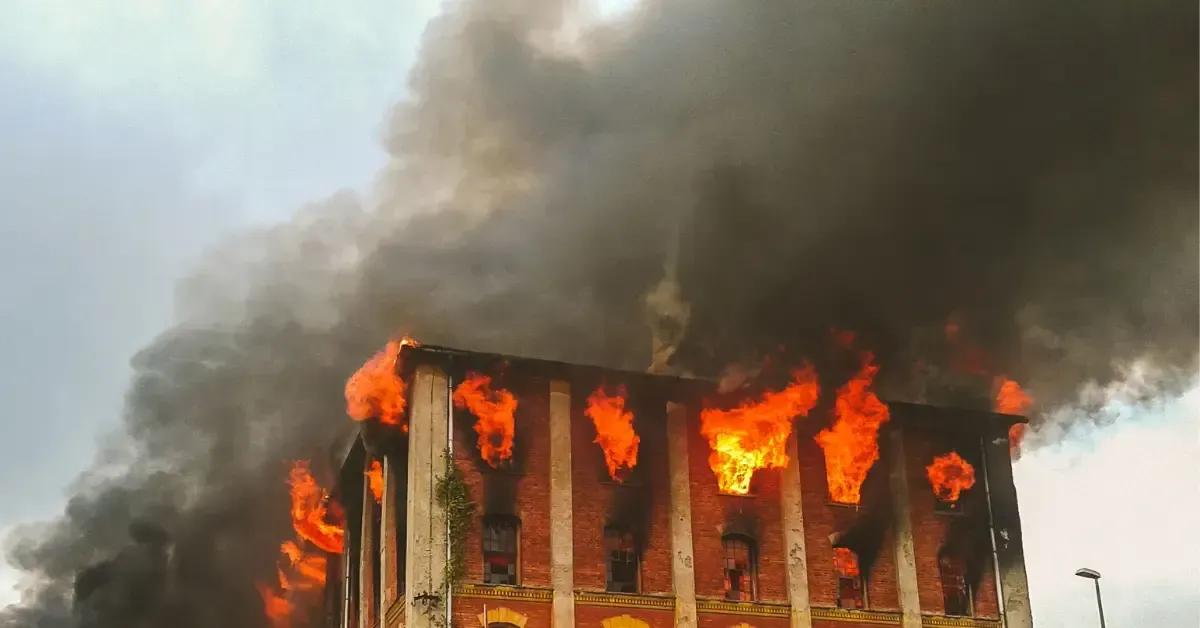
5-Minute Guide on Property Risk Management: Top-10 Causes of Natural Gas Explosions in Commercial Buildings
Intended Audience: Commercial Building Owners, Facility Managers, Security & Safety Professionals.
Natural Gas Facts:
In its “natural” state, it is colorless, odorless and tasteless.
Before it gets into the distribution system, natural gas is mixed with an odorizer chemical that makes it smell like rotten eggs.
Methane (CH4) is the main, flammable component of natural gas and comprises between 74 to 97% of its total volume, depending on the quality of the gas.
The explosive or ignition range of natural gas is between 5 to 15% by volume of air.
Below a 5% concentration there is not enough natural gas to explode.
Above 15%, enough oxygen is displaced so as to prevent a natural gas ignition.
The ignition range of natural gas is between 1,000 to 1,200-degrees Fahrenheit.
The temperature range of an average appliance pilot light is between 750 to 1,400 degrees.
Natural Gas is 30 to 40% lighter than air allowing it to accumulate in pockets.
77% of large commercial buildings in the U.S. use natural gas for space heating.
U.S. Natural Gas consumption has increased around 30% over the last 10-years.
Over 22,000 U.S. businesses convert to natural gas annually.
The U.S. is currently the World’s largest producer, consumer & exporter of natural gas.
The Natural Gas Explosion Risk:
The National Fire Protection Association(NFPA) estimates that there are as many as 400 serious natural gas explosions causing death, injury or property damage in U.S. businesses and homes annually.
If natural gas continues to leak after the initial explosion, there is the potential for secondary explosions that can serious hamper rescue and firefighting efforts.
After a natural gas explosion, there is a high probability of a subsequent fire due to dislodged of combustible materials, burning embers and other ignition points.
There are around 200,000 natural gas building leaks that require emergency responders annually in this country.
In 1944, an explosion at a natural gas storage facility east of Cleveland, Ohio, killed 151-people, injured another 225 and completely devastated a 1-square mile area.
In 2018, a series of natural gas pipeline explosions caused an estimated $1-Billion in property damages in northeastern Massachusetts.
As recently as December, 2025, a natural gas explosion in a Bristol, Pennsylvania nursing home killed two and injured 20.
The Top-10 Causes of Natural Gas Explosions in the U.S. :
Leaking Natural Gas Lines are the most common NG leaks & are primarily caused by pipe corrosion.
Improper Installation of Piping or Equipment that is caused by poor connections, improper sealing and pipe size mismatching.
Damaged Pipes or Equipment during renovation work, primarily caused by impact damage from drilling, hammering, nailing or improper rerouting of pipes.
Aging Lines & Equipment resulting in rusting or corrosion, often because of the accumulation of moisture in the piping.
Pockets of Natural Gas that can accumulate in utility rooms, basements & behind walls that are just waiting for an ignition source such as a lit pilot light, open flame or an electrical short.
Human Error such as negligence, maintenance or operating errors like accidentally opening gas values.
Building or Ground Movement caused by settlement or earthquakes.
Inadequate or Failed Gas Line Regulators often caused by the early wear of their internal components.
Poor Quality Natural Gas that can increase internal pipe corrosion & deterioration.
Pipe Overpressure caused by pipe blockages, regulator failure or human error.
How Natural Gas Leaks are Detected:
By training employees to respond to any “rotten egg” smell, unexplained hissing sounds, or higher than normal gas usage.
The installation of stationary natural gas sensors in boiler/mechanical rooms, interior gas meters, utility closets and commercial kitchens.
Using handheld natural gas sensors to test for natural gas along gas lines, valves, and joints to gas fired appliances.
Having a licensed professional conduct a test to determine if the gas distribution system holds pressure.
What to do if a Natural Gas Leak is Suspected:
Evacuate all occupants immediately from the building.
Personnel should not use phones, elevators or operate electrical switches during the evacuation.
If possible leave doors and window open to ventilate the building.
Do not attempt to turnoff the lights, electricity or ventilation.
Only trained personnel should attempt to shut off the gas before leaving the building.
Have all evacuated personnel move to a safe area away from the building and conduct a headcount.
Call 911 and report the building’s street address and the nature of the emergency.
Be prepared to assist emergency responders by indicating the location of the gas shutoff valve and major gas fired units.
Do not reenter the building unless OK’ed by the emergency responders and the gas company.
Have qualified personnel determine the cause/location of the leak and see that repairs are promptly made.
Key Takeaway:
When it comes to natural gas leaks, training, caution and prompt response times can save both lives and property.
About the Author:
Rob Brooks is the Loss Control Manager for Centurion Insurance Services in Charleston, West Virginia. He has over 40-years experience in his profession having worked for some of the leading insurance carriers and brokers. Rob has professional certifications in both human resource management (CHRS) and workers compensation (CWCP) from Michigan State University’s School of Human Resources & Labor Relations.
Disclaimer
This publication is intended for general educational purposes only, and not to be considered as business, financial or legal advice. Centurion Insurance Services and the writer makes no guarantees or warranties of any kind, express or implied, about the reliability, completeness or suitability of the information contained herein. Readers should consult with appropriate professionals before making any decisions based on the content of this newsletter. We will not be liable for any losses or damages arising from the use of the information provided.
